Season 1 · Episode 03
Clearing the Way
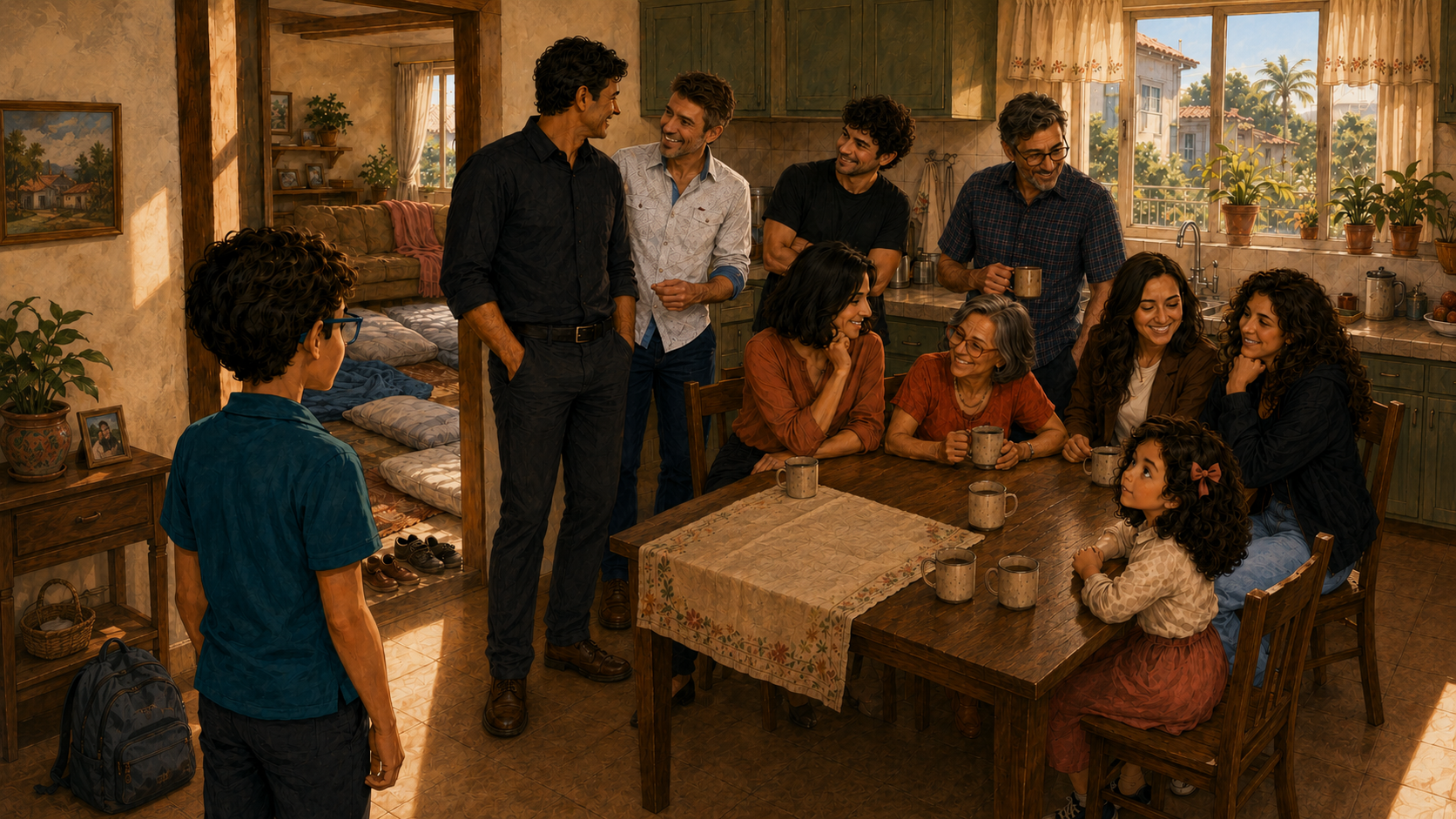
Júlio woke up with the impression that the house had shrunk during the night.
There were mattresses in the living room, a blanket draped over the back of the sofa, and shoes lined up by the door. In the kitchen, there wasn't room for everyone to sit around the table. Even so, each of them found a spot close enough to listen.
The daily text lay open. Pedro had asked Júlio to read it, as he had the day before, and Júlio worked hard to keep his voice from stumbling. That day's reading was Numbers 11:4-6. It told of Israelites who, in the wilderness, remembered the food they used to have in Egypt and began looking at the manna as if it were nothing.
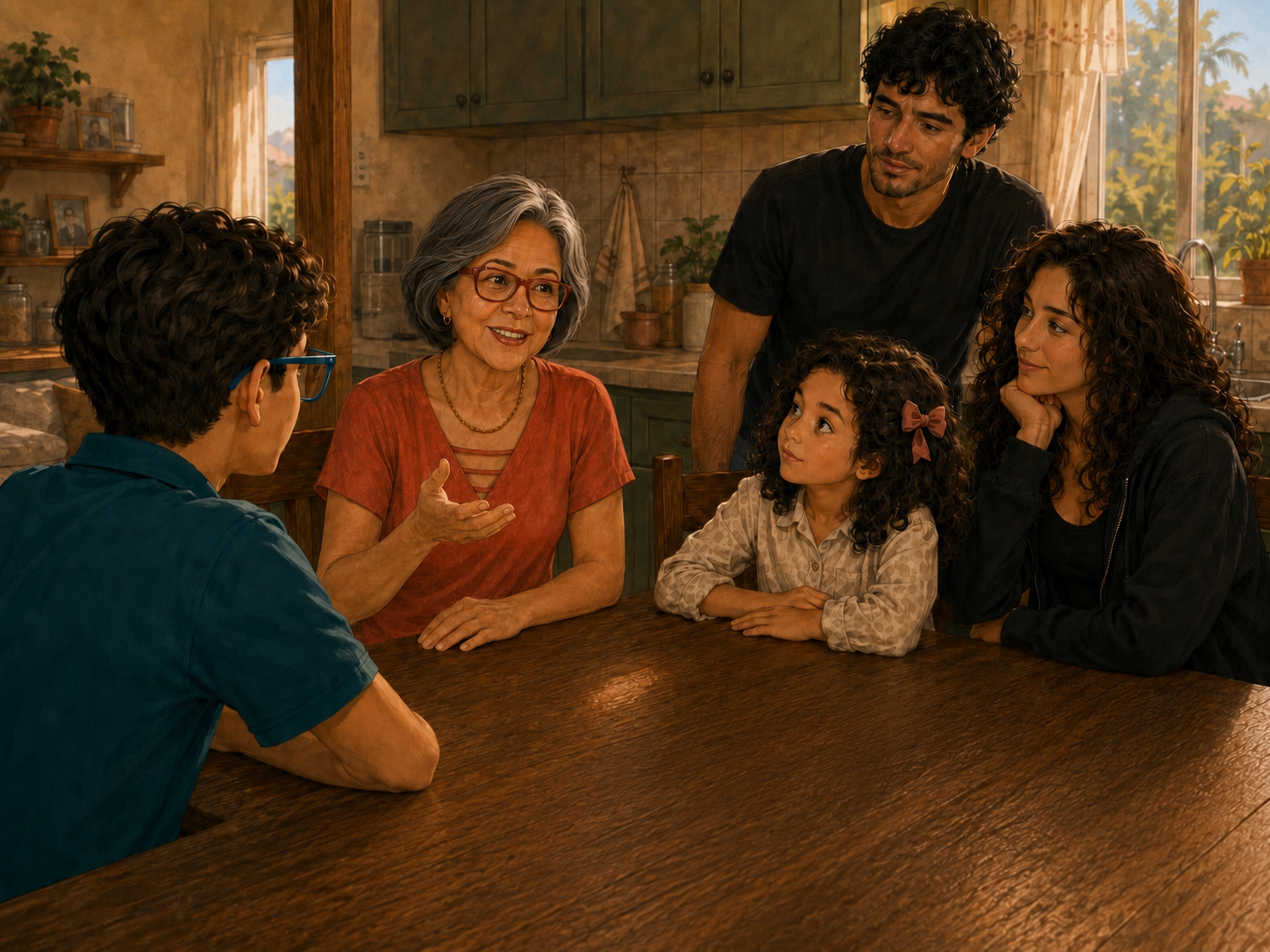
"The Israelites had been through real hardship," Sara said. "So I don't find it strange that they remembered what used to be comfortable. I think all of us are doing a bit of that."
Lia looked at her.
"I miss taking a hot shower."
Júlio said nothing. He missed many things: turning on the fan before going to sleep, playing video games after school — all things he had taken for granted, because they had always been there. It was strange to be finding that out now. He even missed complaining about school on a Monday.
Sara didn't tell them they were wrong to miss those things.
"Missing something isn't ingratitude," she said. "But we don't want to let what we miss blot out what Jehovah has already done for us. We survived, we're together, and we managed to find one another."
Noeli had been quiet until then, her hands wrapped around an empty glass.
"I miss hearing from people," she said. "From my mother. From my siblings."
Júlio looked up. Grandpa Mário and Grandma Sara lived a few streets away, and Uncle João in the next neighborhood over. But his mother's family lived in Jundiaí. Before, it was half an hour by car. A phone call to say they were on their way.
"The phone doesn't work," Noeli went on, slowly. "No cars come through, no one arrives from there. I know they weren't alone. I just wanted to know how they are."
No one tried to answer quickly. Júlio had woken up missing things. It hadn't occurred to him that his mother might be missing people.
"As soon as the roads open up, we'll go there," Pedro said. "Not today. But we will."
Noeli nodded. She didn't look resigned, and she didn't look hopeless either. Both things lived together on her face.
"We should ask Jehovah in prayer to help us be patient until we can find our relatives who live far away," Mário added. "He knows where each one is. We can miss what's gone and still be thankful for what we have today."
Pedro closed the conversation with a prayer. He gave thanks that they were all alive, asked for patience for the day ahead, and for help to take care of one another. He also asked Jehovah to care for Noeli's family and for everyone they had not yet managed to find. Júlio bowed his head, but his mind caught on the word "patience." It seemed easy to say when there was water, electricity, food, and a bed of his own. Now it seemed like something that had to be practiced all over again every minute.
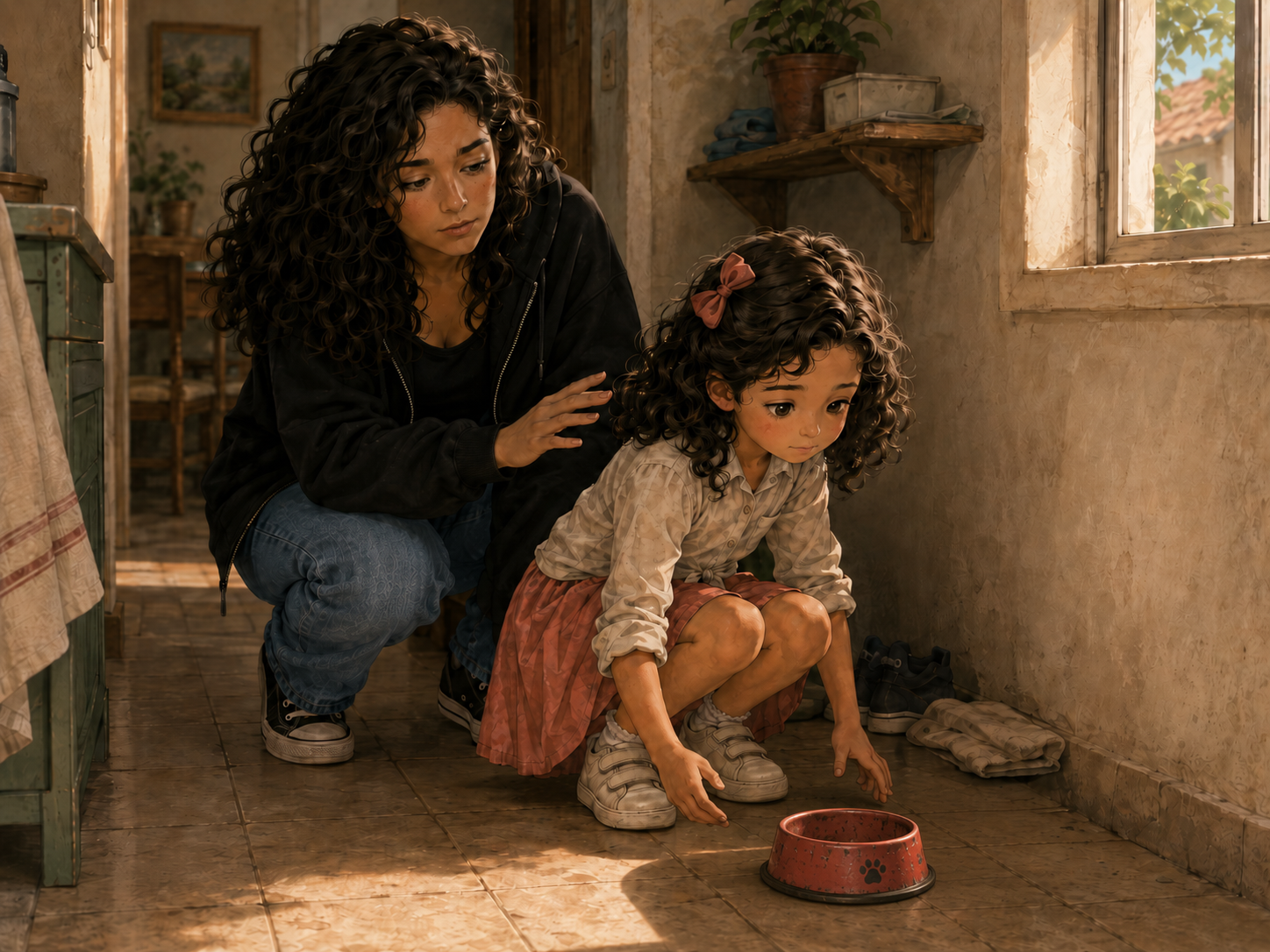
When the prayer ended, Lia left her spot and went over to Mamão's empty bowl, which had stayed near the door.
"He always came when I called," she said.
"He really is a beautiful beagle," Carla said. "I kept looking for my kitties too when we came out of the basement. I couldn't find Mufasa or Ketty."
"Do you think they're okay? Do you think they know the way back?"
Carla took a while to answer.
"I hope so."
Lia set the bowl back in its usual place. Carla stood beside her for a moment, unable to find anything to say.
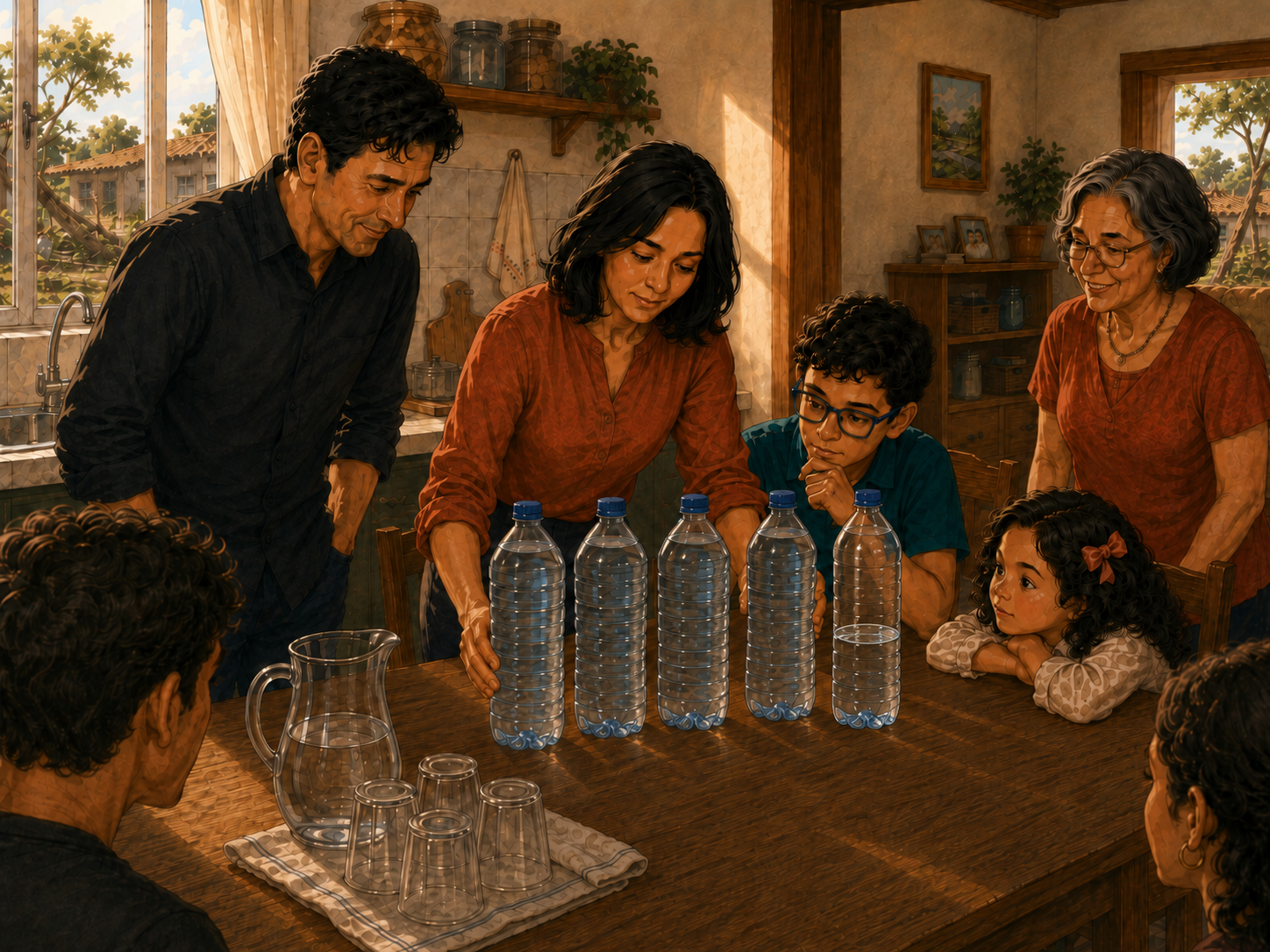
Then Noeli brought what was left of the reserve to the table. Júlio knew those bottles by sight. For years they had sat at the back of the cupboard, swapped out and checked from time to time by his parents, without his ever imagining that one day they would be opened for a table full of people.
Noeli lined the bottles up on the table. There weren't many. Beside them she set a pitcher and a few clean glasses.
"This reserve got us through the night," she said. "We used it carefully, and it's still here. But now there are ten of us."
Júlio counted the faces without meaning to. Grandparents, parents, uncle and aunt, Márcio, Carla, Lia, and himself. Ten. The afternoon before, Lia had asked to wash the dishes, and no water had come from the faucet. That silence from the sink came back to him every time he saw a half-empty bottle.
"We don't have to wait until we reach the last one to look for more," Noeli went on. "If we do this together, we can take care of the reserve we have and go for more water before it runs out."
"The municipal water tower," João said. "It's up the hill, a few neighborhoods farther on."
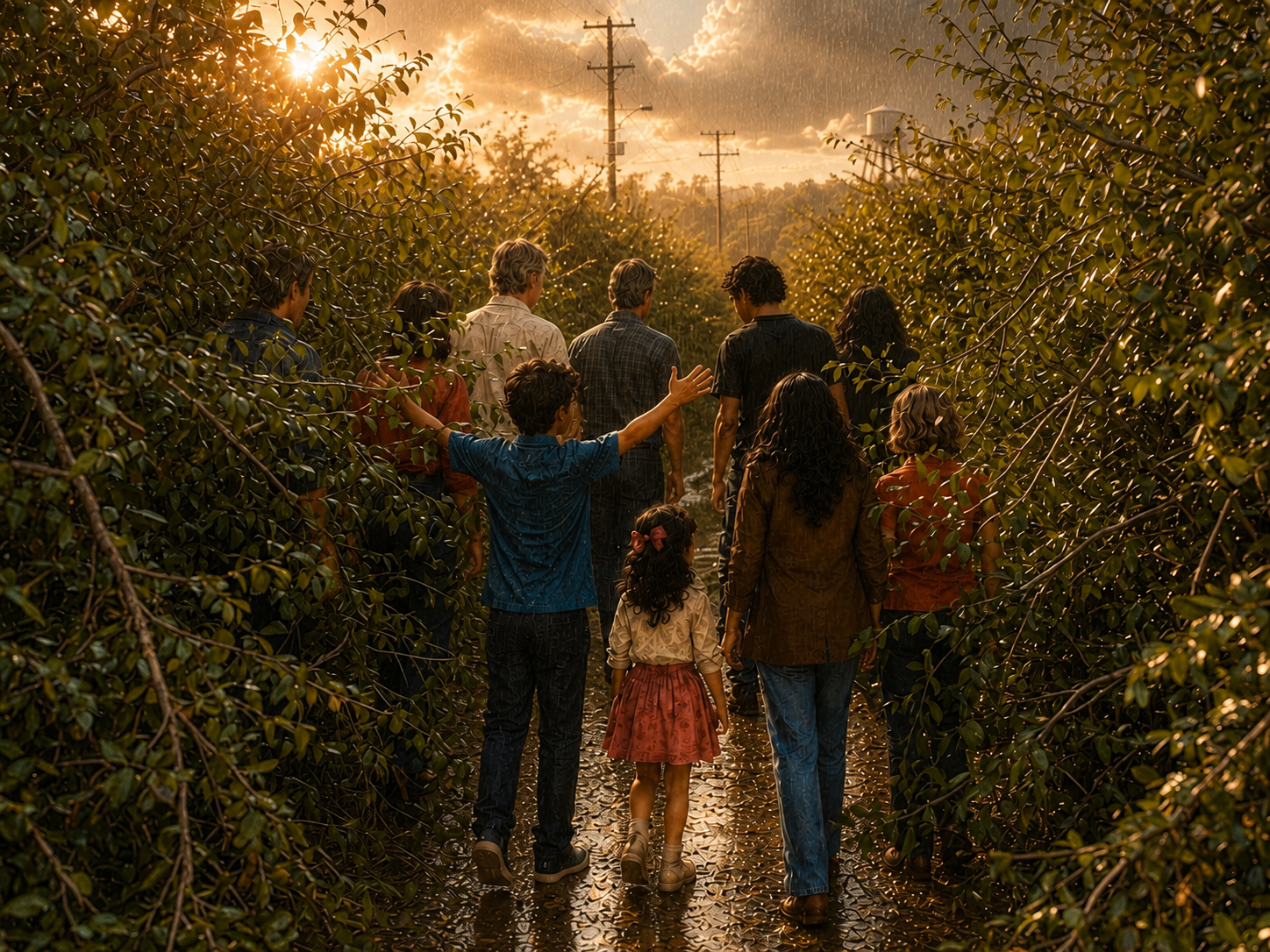
"I can take everyone along the trail," Júlio said.
He spoke louder than he meant to. The afternoon before, seven people had followed him through the brush, and Márcio had said they were going to need to know those paths now. The sentence had stayed with him all night.
João didn't answer right away. He looked at Júlio like someone genuinely considering it.
"The trail is good," he said. "It got us there yesterday. Today is something else. Think it through with me: how many of us are going down?"
Júlio looked around the table.
"Everyone."
"And each one comes back carrying what?"
"A bucket. A pot. A bottle."
"Full," João finished. "You went through that brush with your hands free. Now picture your grandmother coming back with a full bucket, over slippery ground, with branches at face height."
Júlio pictured it. It took no time at all.
The trail was still there. It was still his. It had just served a day that was already over.
Pedro was quiet for a moment, looking out the window. From there the street looked whole, and it wasn't: farther on, the trees still lay across it.
"Then let's open up the street," he said. "No rushing, and nobody trying to do alone what needs to be done as a group."
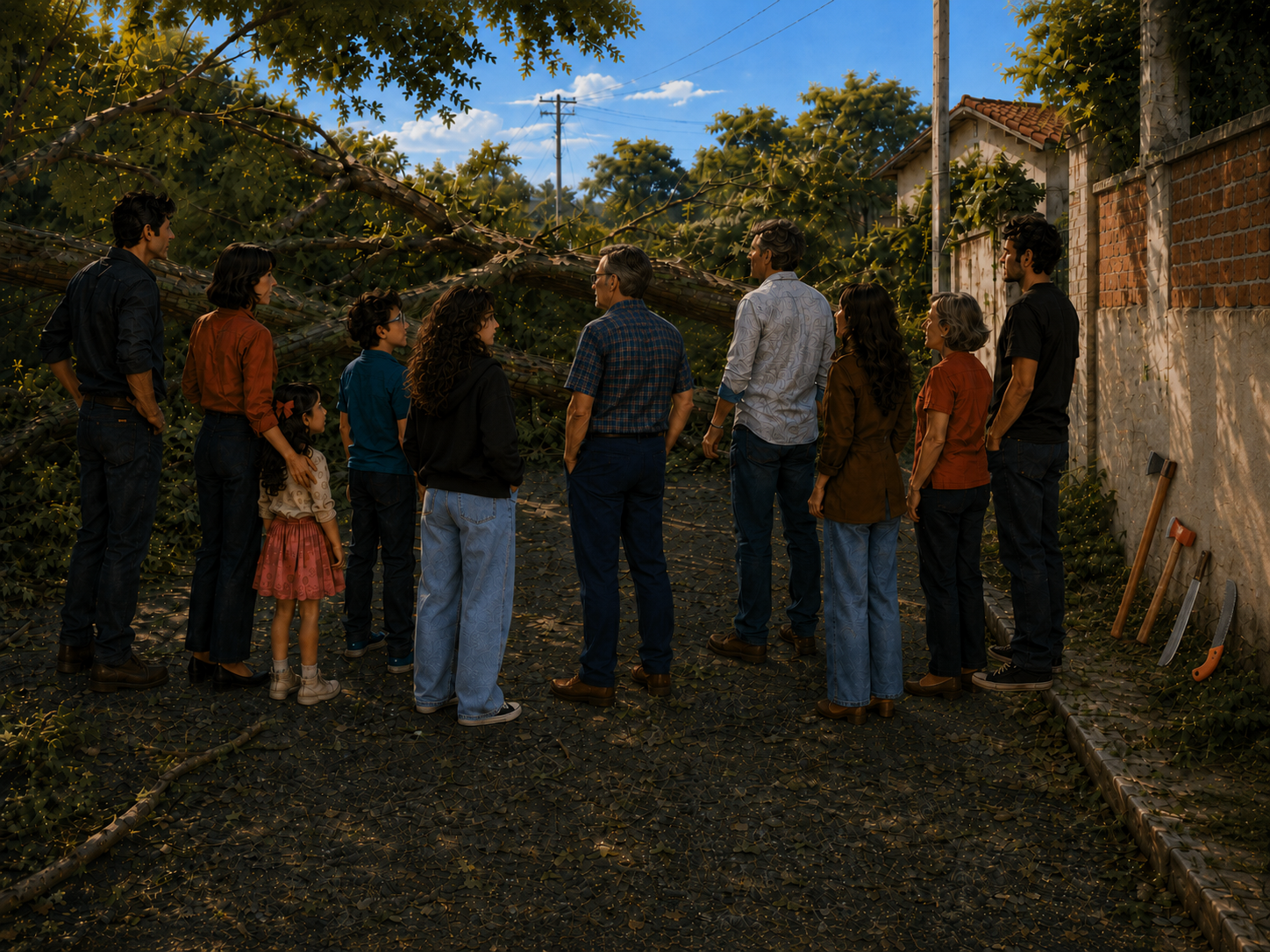
A little later, they all stood before the fallen trees. João and Mário came back from the houses with axes and machetes and leaned everything against the wall, away from where the children were.
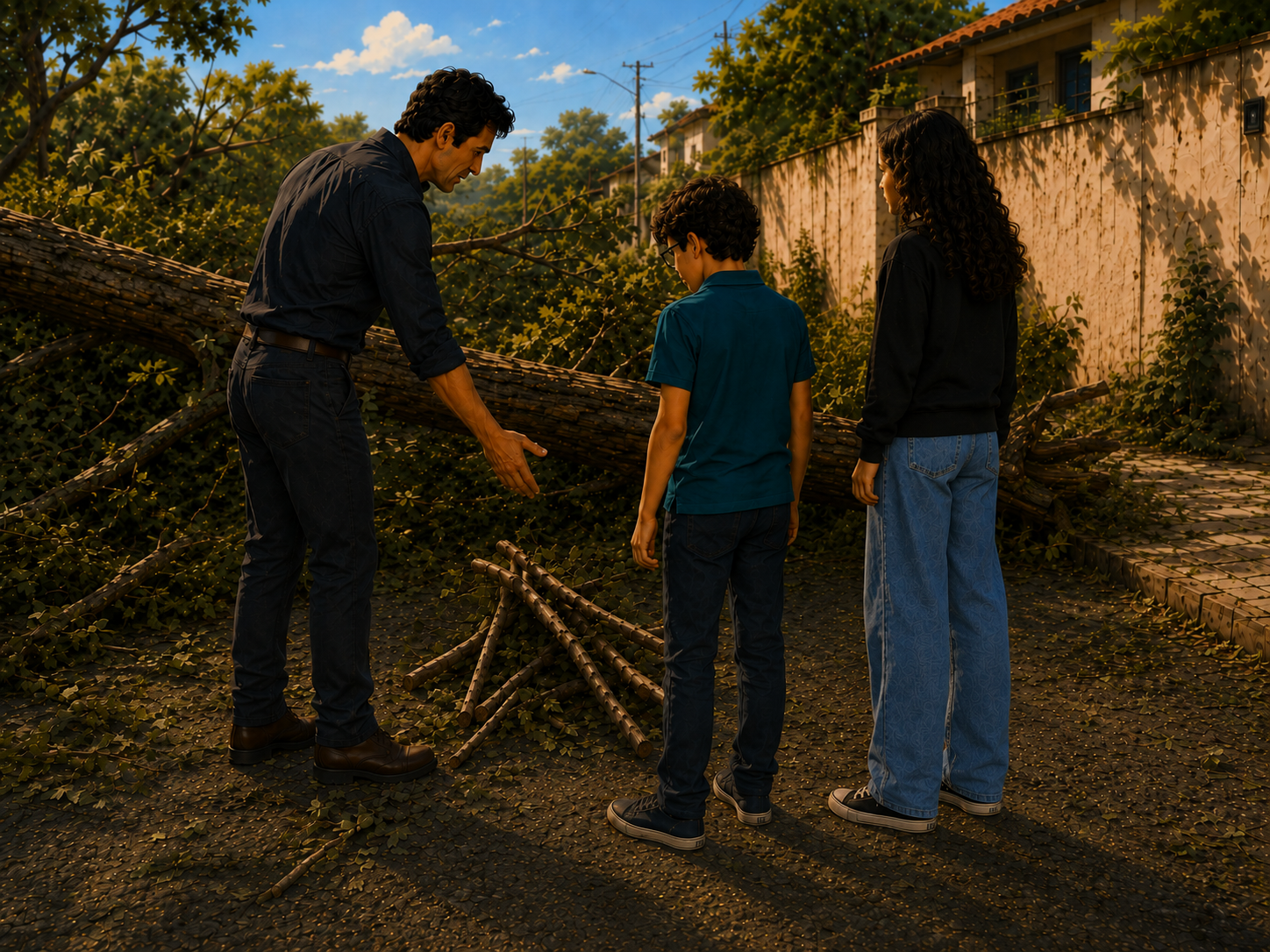
Pedro asked that no one start yet. He pointed at a bent branch, one end pinned under the trunk.
"A pinned branch stores force," he said. "Nobody goes near anything that's still pinned."
Júlio looked at the bent branch. He didn't want an axe. He had no idea how to use one and didn't want to find out. Márcio took an axe from João and joined the adults, and Júlio waited for the task that would fall to him.
Pedro pointed at some branches already lying loose on the ground.
"You can help with these. Carry them to the sidewalk, if they're light. Sorting out leaves and twigs will clear the ground too. If anything is stuck or heavy, call an adult."
Júlio looked at the tree lying across the street. It was bigger than it had seemed from inside the house.
"Before, when a tree fell, a city truck would come," he said, without planning to say it.
"It would, son," Pedro answered. "Now it's us."
It wasn't a comforting answer. It was just true.
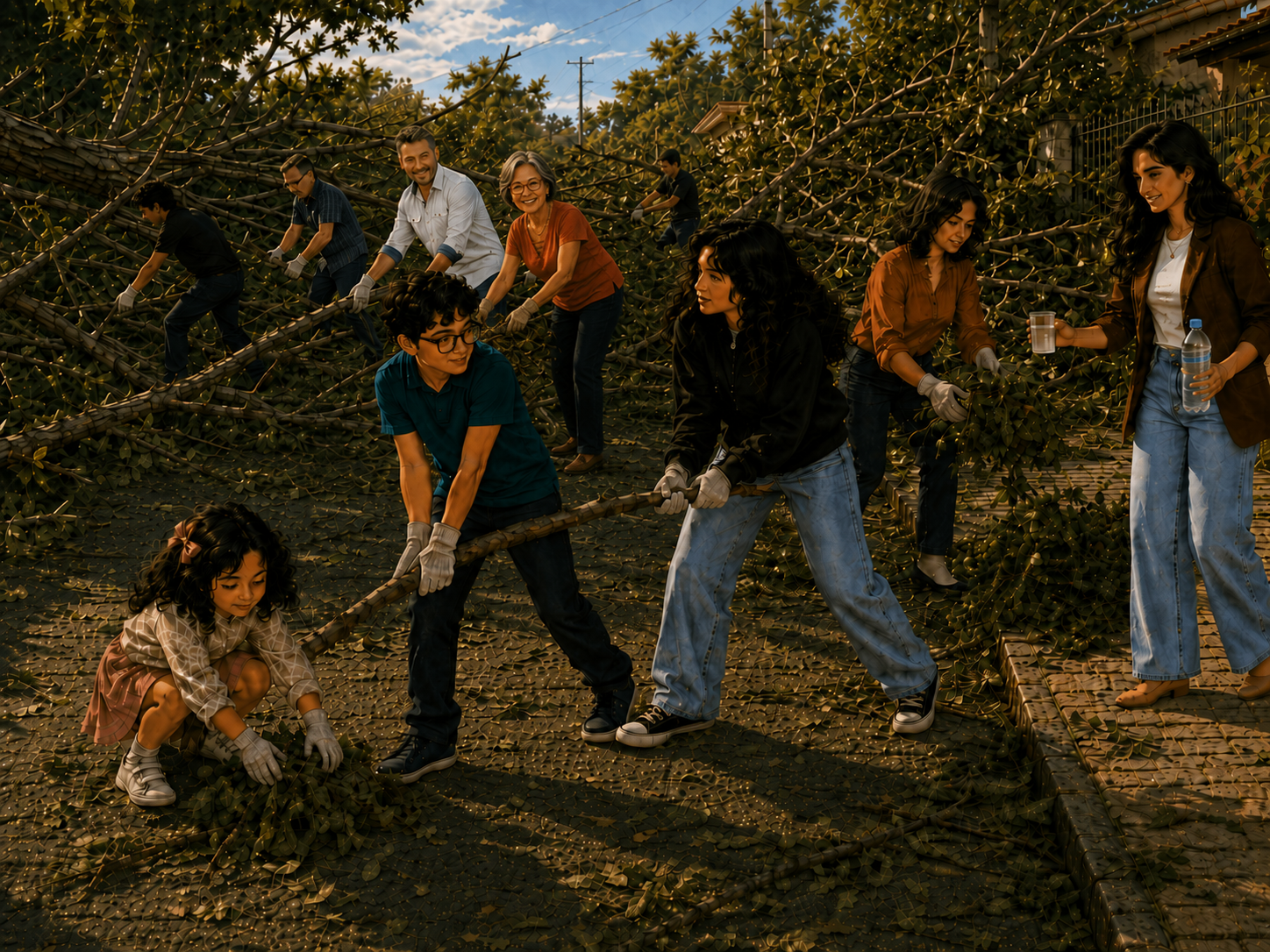
Júlio took hold of the end of a branch. It was light enough for him to drag to the sidewalk. Carla took the other end, and the two of them went back together for the next one. Lia gathered leaves into small piles, well away from the adults, and Noeli carried the piles to the sidewalk when they grew too big for her. Bianca brought water to whoever was working, always a little at a time, because it was the same reserve Noeli had set on the table that morning. She also called out when it was time to get out of the way.
Júlio had crossed that street his whole life without looking at the ground. He went to the bakery, came back from the field, rode past on his bike with one hand on the handlebars. The street was something that was simply there, ready, without anyone in his house having to do anything for it.
Carla stopped to look at her own hands.
"I'm going to get calluses," she said, and she didn't seem upset about it.
The passage appeared slowly. First a patch of asphalt. Then a stretch of sidewalk. Then enough space for a person to cross without ducking. Júlio watched it grow and couldn't find it beautiful. All he could think about was the size of the street that used to be there.
"A little more," Pedro said, pulling a branch that had already come loose.
Júlio picked a thicker one and planted his feet. His arms burned and the branch moved half a handspan. He pulled again. Half a handspan.
"Not that one," Pedro said behind him. "The end is pinned under the trunk."
Júlio let go. He hadn't seen the end. He was left with stinging hands and nothing to show for it, and nobody said he had almost done it. He found a thinner one. That one made it to the sidewalk, and behind it the ground lay clear where leaves and twigs had been. The adults could move with surer footing.
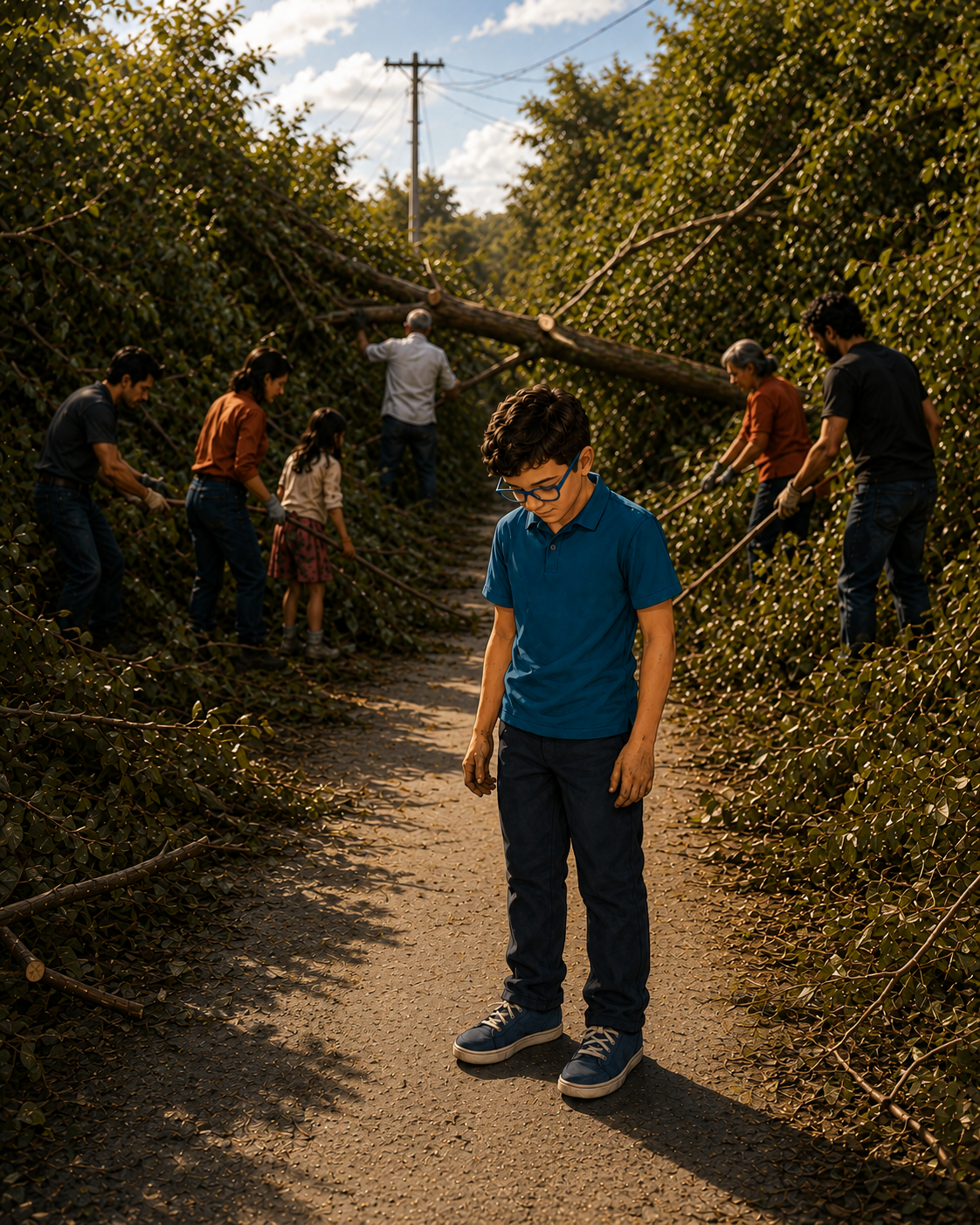
Márcio came back from where the trunks were, his shirt stuck to his back and a thin scratch on his forearm. He stopped beside the two of them and looked at the clear ground running to the sidewalk.
"You cleared all that?"
"We just kept pulling," Júlio said.
"We only got to the trunks because you two cleared the way ahead."
Márcio said it as he turned away to get water with Bianca.
Júlio tried to see what his cousin had seen. At first he couldn't. He kept seeing a street that needed a whole morning of work to be almost ready.
Then he looked down at his own feet. He was standing on asphalt. When they had arrived, no one could have said what color the ground of that street was.
He kept looking down a little longer before going to fetch the next branch.
It wasn't long before Mário came over to them.
"There we go," he said. "We can get through now."
It wasn't a perfect street. There was still a tree lying on its side, leaf stains on the asphalt, and a stretch of uneven ground. But there was an open lane. Pedro called the families over and asked them to cross slowly, first without carrying anything, without drifting apart from one another.
When Júlio stepped into the opening, with Lia right behind him, the far side of the street was still silent, but it seemed longer than before. Above the rooftops, far in the distance, he saw the municipal water tower. It was only a tall shape against the bright sky. He caught himself trying to count how many streets were left between here and there.
"Is that it?" Lia asked.
"It is," Pedro answered. "But let's rest a while and come back in the afternoon with the containers."
A cold drop landed on Júlio's arm. Another came after it, too small to make a sound on the asphalt. Within seconds, a light rain began to streak the street, washing some of the dust off the leaves.
Júlio opened his hands palms-up before he thought about what he was doing. The water barely gathered in them.
"If it lasted, we could use it," Márcio said, looking up. "That one there won't fill half a bucket."
Nobody ran. It was too brief and, after a morning of work, it felt more like a surprise than a bother. Under the fine rain, they started back home.
Halfway there, the rain stopped, and the sun came out from behind a thin cloud.
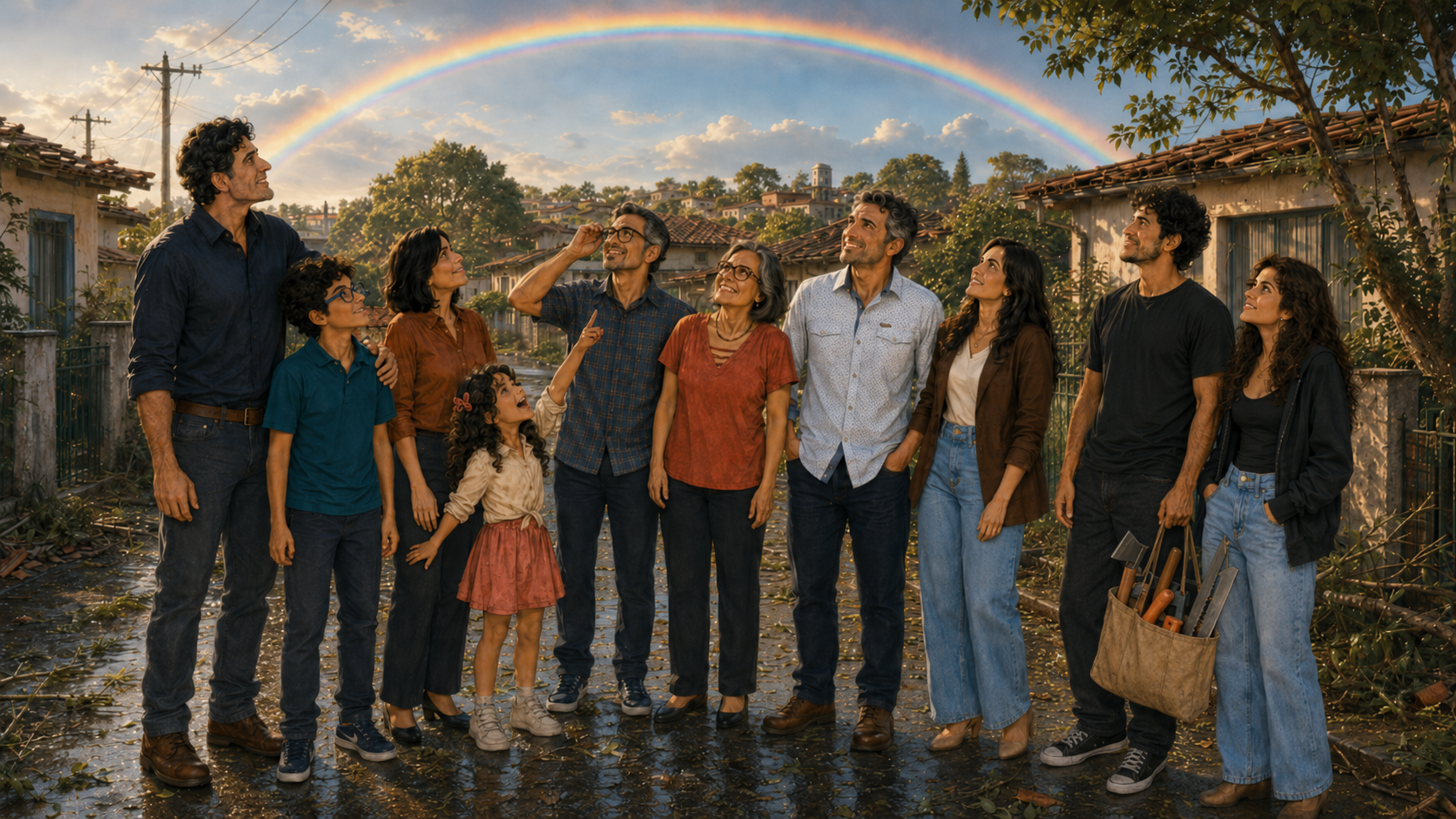
"Look!" Lia pointed at the sky, her mouth open.
Above the rooftops, a rainbow appeared whole, sharp against the returning blue.
Mário took off his glasses, wiped the lenses on the hem of his shirt, and put them back on before looking. Márcio stopped, holding the tool bag. João slowed his pace, and nobody behind him complained.
Little by little, everyone drew close together, without arranging it.
"It looks like the sky drew a bridge," Lia whispered.
Noeli smiled. Her eyes turned bright, but her voice stayed calm.
"It reminds me of the guarantee Jehovah gave Noah: there would never again be a Flood to destroy the earth."
Pedro looked at the colors for a moment, his hand on Júlio's shoulder.
"And we won't have to go through Armageddon again either."
Júlio knew how it worked. Sun and rain at the same time, and the colors appeared. He had seen it many times, on ordinary days, without anyone stopping to look. That rainbow hadn't appeared to tell them anything. But everyone had stopped to look, and Júlio stayed with them.
Júlio thought about the lane of street they had managed to open. It wasn't the street from before. It would never again be the street from before. But his arms ached, his hands were dirty with leaves, and the passage existed.
Lia shortened her steps until she was walking beside Sara.
"Grandma, did Noah feel this too?"
"Feel what?"
Lia looked at Júlio, who was coming along behind them. It took him a while to find the words. They were all crowded together inside him, and it was hard to pull them out one at a time.
"We stayed down there listening to the world end," he said. "Then we opened the door, and everything was quiet. Noah was shut in with his whole family too, while the Flood happened outside."
Sara didn't answer right away. She was walking slowly, and the two of them went slowly together.
"I think so," she said at last. "They came out to a clean, empty earth, with no one around to ask where to begin. They must have missed many things that no longer existed. And even so, the first thing they did was thank Jehovah."
"Before setting up a place to live?" Lia asked.
"Yes."
Júlio thought about that the rest of the way. Noah's family had waited behind a closed door while the old world ended, and then they had stepped out into a silence much like this one. Nobody had explained to them what the first day would be like. They simply began.
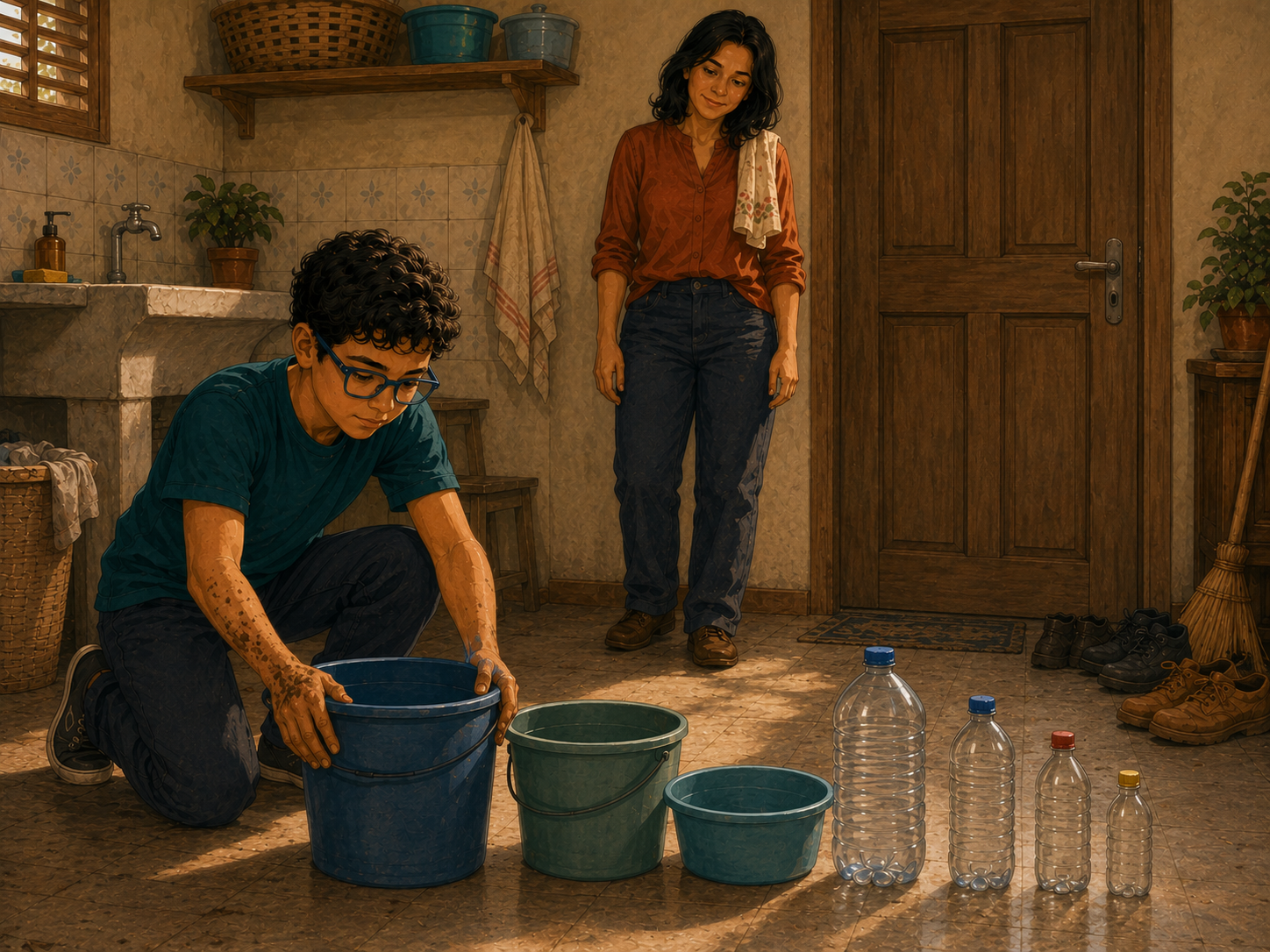
At home, while the others looked for shade and took off their shoes, Júlio went to the laundry area. He found two buckets, a deep basin, and four empty bottles. He carried everything over by the door and lined it up on the floor, from largest to smallest, the way he had seen his mother line up the bottles on the table that morning.
Noeli stopped behind him, a towel over her shoulder.
"Nobody asked for this."
"I know," Júlio said, and went to get the ones that were missing.
When he finished, there were more containers than he had expected to find. Empty, they weighed almost nothing. But in the afternoon, full of water, they were going to weigh plenty.